
How an Academic City Student Built a Drone to Protect Maize Farms from Fall Armyworm
August 7, 2026 2026-08-07 13:15How an Academic City Student Built a Drone to Protect Maize Farms from Fall Armyworm

How an Academic City Student Built a Drone to Protect Maize Farms from Fall Armyworm
Imagine investing months of hard work into a maize farm, only to watch an invisible enemy wipe out your harvest in a matter of days. This is the reality of many African farmers battling the Fall Armyworm. While many see the pest as an unavoidable threat, one Academic City student saw an engineering problem waiting to be solved.
Since 2016, a tiny but destructive pest called the Fall Armyworm has swept across the continent. According to FAO Global Action on Fall Armyworm Control, the pest now reduces maize yields by as much as 73% and inflicts an estimated USD 9.4 billion in annual economic losses across Africa alone. The numbers are staggering. Across Africa, Fall Armyworms destroy billions of dollars worth of maize every year, threatening the livelihoods of millions of smallholder farmers. It mostly hurts small family farms, the very people who, according to FAO’s own research on family farming, produce up to 80–90% of food in parts of sub-Saharan Africa.
While large commercial farms can afford expensive high-tech drones to protect their crops, everyday African farmers are left behind. Imported commercial drones cost too much, and if one small part breaks, you cannot fix it locally.
For Mohammed, a final-year Computer Engineering student, the challenge was not just about agriculture. It was about whether affordable engineering could solve a problem that imported technology had failed to address. For his final-year project, he built an affordable, smart drone designed specifically to help African farmers save their crops.
Why Fall Armyworm Remains a Challenge for African Farmers
Fall Armyworm has become one of the most serious agricultural challenges affecting maize production in Africa. The pest attacks maize plants by feeding on leaves and damaging crop growth, leading to reduced yields and increased costs for farmers. A survey conducted across Ghana and Zambia found predicted maize losses averaging around 45% in Ghana alone, a staggering hit to smallholder farmers who depend on the crop for both food and income.
The Food and Agriculture Organization has called for integrated, tech-supported approaches to managing the pest, precisely because traditional detection methods can’t keep pace with how fast it spreads.
Traditional detection relies on farmers walking their fields row by row, checking leaves by eye. It works, but it’s slow. By the time the naked eye catches an infestation, the worms have often already caused serious damage. This is exactly the kind of problem that technology, thoughtfully applied, can solve.
Building a Made-in-Ghana Agricultural Drone
“Most drones you buy today are closed systems,” Mohammed explains. “You cannot change how they work and you cannot fix them yourself. We wanted to build a drone where we control everything, using parts we can easily find and fix right here in Ghana.”
Rather than importing an expensive commercial drone, Mohammed started from scratch. Using open-source flight technology, locally sourced electronics, custom 3D-printed components and adaptable software, he built a system that farmers could realistically repair and maintain in Ghana.
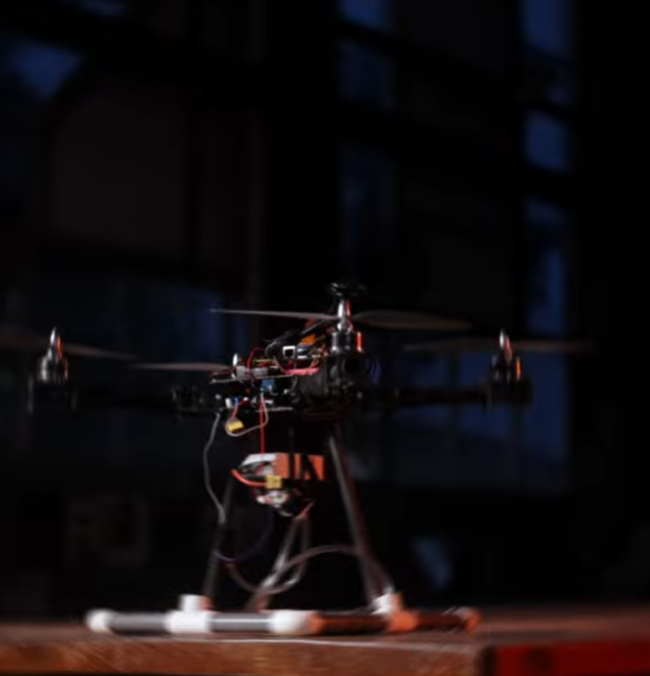
This approach focuses on creating technology that can be maintained and improved locally.
For farmers, this could mean easier repairs, lower costs, and greater independence from imported solutions.
How the AI-Powered Farming Drone Works
Mohammed structured the autonomous drone using three connected layers that work together seamlessly.
At its core, the drone operates through three integrated systems. First comes the hardware—the frame, landing gear and brushless motors that keep it airborne. Next is the flight-control system, which continuously stabilises the aircraft, even in windy conditions. Finally, an AI-powered vision system serves as the drone’s “brain,” identifying infected maize plants in real time.
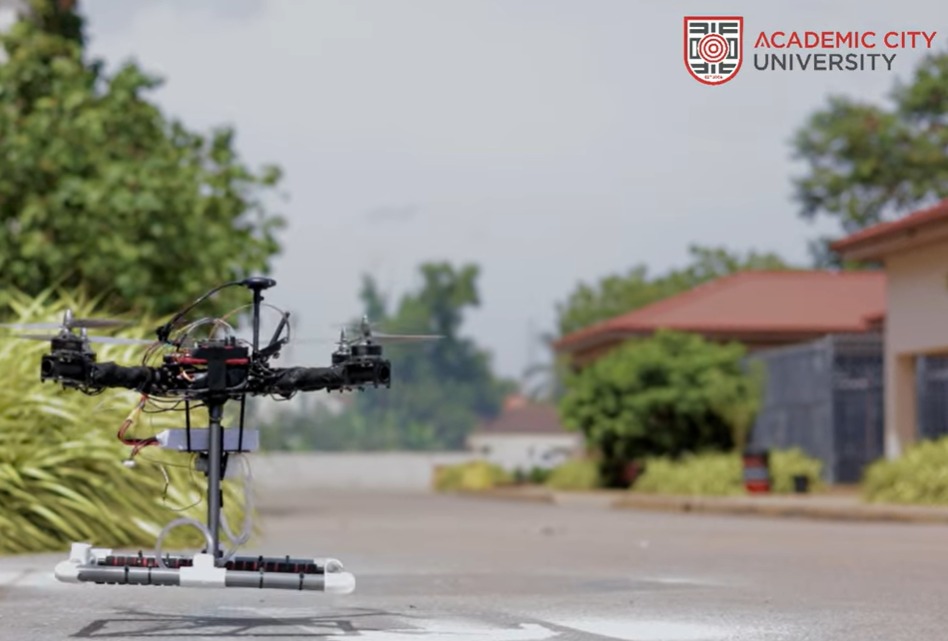
Once an infected plant is identified, the drone acts immediately. Instead of spraying an entire field—a costly and often wasteful practice—it treats only the affected plants. Farmers use less pesticide, spend less money and protect both healthy crops and the surrounding environment. It applies the same principle behind precision-spraying research showing drone applications can cut treatment time by up to 75% compared to manual methods.
Testing the Drone at Agro King Farms
Academic City University encourages students to take their innovations beyond classrooms and laboratories. To evaluate how the drone performs in real farming conditions, Mohammed and his team tested their technology at Agro King Farms in Ghana. By working directly with local farmers, Mohammed was able to see how the drone flies in real-world conditions.
His goal is to scale up this prototype into a larger version that can carry more weight and protect even larger farms across West Africa.
Learn More About the Project ▶
Preparing Africa’s Future Engineers and Innovators
Mohammed’s drone is still evolving, but its purpose is already clear: to give African farmers access to technology designed for their realities rather than imported for someone else’s. It is also a reminder that some of Africa’s most important innovations may not come from multinational laboratories, but from determined students who refuse to accept that local problems require imported solutions.
Africa’s future will depend on graduates who can design technologies that solve local and global challenges.
The development of this agricultural drone by our 2026 Computer Science graduate reflects the kind of innovation Academic City University seeks to nurture, where students apply their knowledge to industries that matter.
In May 2026, Academic City University launched its Bachelor of Science in Unmanned Aerial Systems (UAS) Engineering programme, becoming the first university in Sub-Saharan Africa to offer this degree. The programme is designed to prepare the next generation of engineers to design, build, and deploy autonomous aerial technologies that will transform industries across Africa.
Today’s Computer Science students built a drone to address challenges in agriculture. Tomorrow’s UAS engineers will push the boundaries of autonomous technologies across sectors including agriculture, healthcare, environmental monitoring, and disaster response.
Ready to make your mark?
The world does not need more consumers; it needs creators. Join a community of innovators, thinkers, and makers who are actively changing Africa’s story. Apply to Academic City University today and start your journey!

