
Bachelor of Science in Electric Vehicle Engineering
June 22, 2026 2026-06-23 8:23Bachelor of Science in Electric Vehicle Engineering
Electric Mobility Is Transforming the Future of Transport
Future-Ready Innovators
The global shift toward clean energy, smart mobility and sustainable transport is creating new opportunities across vehicle design, battery technology, charging infrastructure, power electronics, fleet operations and clean-tech entrepreneurship.
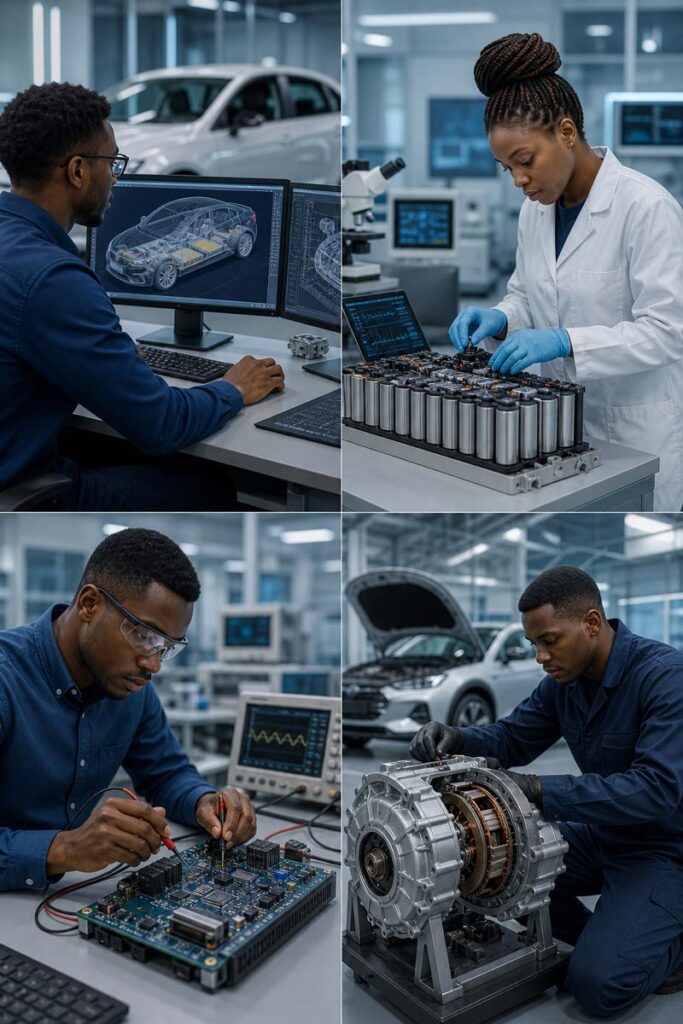
Academic City’s Bachelor of Science in Electric Vehicle Engineering is designed to equip students with the technical, practical and innovative skills needed to design, develop and optimise electric vehicle systems. The programme combines engineering fundamentals with hands-on training in electric drivetrains, battery systems, charging infrastructure, embedded systems, vehicle dynamics and renewable energy integration.
Graduates will be prepared to support Ghana and Africa’s transition to sustainable mobility by contributing to electric vehicle manufacturing, charging networks, battery services, smart transport systems, policy development and clean-tech innovation.
BSc Electric Vehicle Engineering at ACity
The programme prepares students to become future-ready engineers for the emerging electric mobility industry. Students gain strong foundations in mechanical, electrical, electronics and computer engineering while developing specialised expertise in electric vehicle systems.
Through practical labs, industry internships, design projects and capstone work, students will learn to solve real mobility challenges, from low-cost charging solutions and battery monitoring systems to e-bus depot models and locally adapted EV designs.
Top Careers in Electric Vehicle Engineering
Graduates of this programme may pursue careers such as:
- Electric Vehicle Design Engineer
- EV Powertrain Engineer
- Battery Systems Engineer
- Battery Management Systems Specialist
- Charging Infrastructure Engineer
- EV Diagnostics and Service Engineer
- Embedded Systems Engineer
- Fleet Electrification Specialist
- Smart Mobility / IoT Engineer
- Automotive Assembly and Quality Engineer
- Renewable Energy and EV Integration Specialist
- EV Policy, Standards and Sustainability Analyst
- Clean-Tech Entrepreneur
Entry Requirements
Applicants must obtain credits in three core subjects, including English Language, Mathematics and Integrated Science, plus credits in three relevant elective subjects including Physics, Elective Mathematics and Chemistry or an approved equivalent. Applicants must achieve an aggregate score of 24 or better.
Applicants must obtain credits in three core subjects, including English Language, Mathematics and Integrated Science, plus credits in three relevant elective subjects including Physics, Elective Mathematics and Chemistry or an approved equivalent. Applicants must achieve an aggregate score of 36 or better.
Applicants must have credits in five GCE Ordinary Level subjects, including English Language and Mathematics, plus passes in three Advanced Level subjects including Mathematics and Physics.
Applicants must have completed the International Baccalaureate Diploma or Diploma Programme Course with passes in the required subjects, including Mathematics and English.
Applicants must have completed the French Baccalaureate with the required pass mark and overall average.
Applicants must be at least 25 years old and meet the University’s mature applicant requirements.
Applicants with relevant diploma, HND or technician qualifications in Electrical Engineering, Electronics Engineering, Computer Engineering, Electronics and Communication Engineering, Robotics Engineering or related fields may be considered in line with Academic City’s admission requirements.
All foreign qualifications will be referred to GTEC for determination of equivalence and eligibility for admission to tertiary institutions in Ghana.
Electives
Options may include:
- Automotive Chassis Systems
- Energy Storage in eMobility
- Automotive HVAC Systems
- Autonomous and Connected Vehicles
Course Outline
- Introduction to Engineering
- Introduction to Programming with Python
- Physics I: Mechanics
- Calculus I
- Engineering Lab I: Circuits
- Technology and Society
- Communication Skills I
- Communication Skills II
- Introduction to Philosophy
- French Language I
- Physics II: Electricity and Magnetism
- Programming in C
- Calculus II
- Circuit I
- French Language II
- Introduction to Materials Science and Engineering
- Chemistry for Engineers
- Linear Algebra
- Circuit II
- Computer-Aided Design and Manufacture
- Engineering Thermodynamics
- Concepts in African Leadership I
- Fundamentals of Innovation and Entrepreneurship Seminar I
- Digital Systems and Logic Design
- Probability and Statistics
- Sensors and Instrumentation
- Engineering Lab II: Digital Systems Design, Sensors and Instrumentation and Electromagnetics Wave
- Fluid Mechanics
- Hybrid Electric Vehicles
- Concepts in African Leadership II
- Fundamentals of Innovation and Entrepreneurship Seminar II
- System Dynamics
- Signals and Systems
- Waves and Optics
- Microprocessors and Microcontrollers Programming
- Battery Technology and Energy Storage Systems
- Differential Equations and Numerical Methods
- Engineering Lab III: Engineering Design: Project I
- Engineering Lab IV: Engineering Design: Project II
- Fundamentals of Innovation and Entrepreneurship I
- Embedded Systems
- Automatic Control Systems
- Mechatronics Systems Design
- Research Methods
- Electric Vehicle Powertrain Systems
- Project Management, Engineering Economics and Risk Analysis
- Industry Internship
- Power Electronics
- Vehicle Dynamics and Control
- Embedded Systems for Renewable Energy
- Electric Vehicle Charging Infrastructure
- Energy Storage in eMobility
- Automotive Chassis Systems
- Project Phase I
- Professional Ethics and Values
- Environmental Science and Engineering
- Advanced EV Design
- Battery Thermal Management
- Automotive HVAC Systems
- Autonomous and Connected Vehicles
- Project Phase II
- Engineering Design Projects
- Industry Internship
- Capstone Research Project
Why ACity
- Home to students from over 23 countries across africa
- Houses a digital makerspace and a technology & Entrepreneurial center for creative freedom & innovation
- A fully digitized campus with the fattest internet speed in a ghanaian university
- Experienced Faculty with industry experience. Student-to-faculty ratio 5:1
- 70% practical lessons
- Every ACitizen has the opportunity to do a work placement every vacation

