
BSc Biomedical Engineering
March 5, 2025 2026-06-19 8:06Bachelor of Science in Biomedical Engineering
Advancing Healthcare Through Engineering Innovation
Train to build life-saving devices, transform healthcare systems, and lead innovation across Africa and beyond.
Biomedical Engineering at Academic City University equips you with the skills to solve real health challenges using advanced engineering and technology. Through project- based learning, hands-on laboratories, and industry-aligned training, you’ll graduate ready to design medical devices, develop AI-enabled healthcare systems, and engineer rehabilitation solutions that improve and save lives.
BSc Biomedical Engineering at ACity
The BSc Biomedical Engineering programme at Academic City University is built on a strong foundation of engineering design, systems thinking, and problem-solving, applied directly to healthcare challenges. Students are trained to analyse biological systems, model complex processes, and develop practical solutions that improve patient care and healthcare delivery.
Through a curriculum grounded in design, analysis and modelling, programming, and artificial intelligence, students gain the technical depth required to engineer medical technologies, from intelligent diagnostic systems to rehabilitation and assistive devices. Biomedical science and human physiology provide essential context, enabling students to design technologies that are safe, eNective, and human-centred.
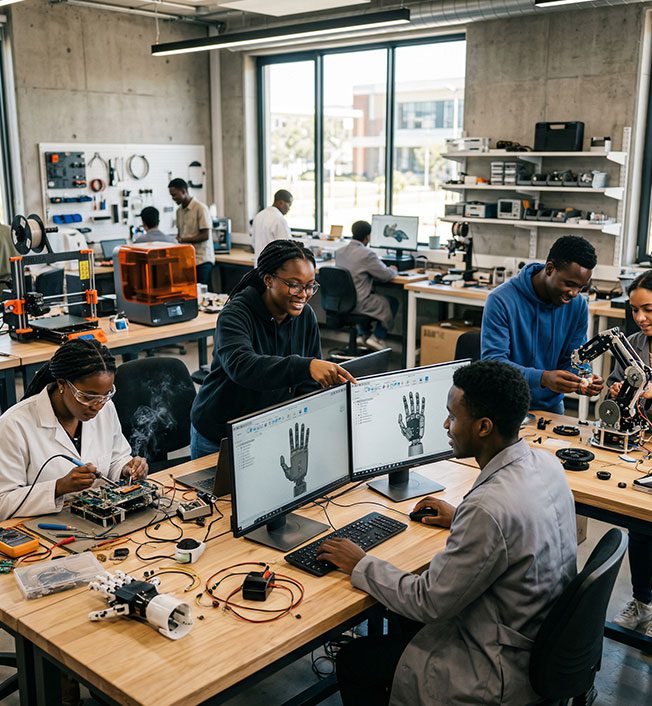
With a 70% practical, hands-on structure, students learn by doing through working in laboratories, design studios, and project teams to prototype, test, and refine real-world biomedical solutions. This approach ensures graduates are not only technically competent, but confident innovators ready to contribute to modern healthcare systems.
Career Pathways in Biomedical Engineering
In just four years, you’ll develop the engineering expertise to design, innovate, and deliver technologies that improve healthcare outcomes and save lives across Africa and globally.
- Biomedical Signal & Medical Imaging Engineer
- Medical Device & Product Development Engineer
- Biomechanics & Rehabilitation Engineer
- Clinical Engineering & Healthcare Technology Specialist
- Tissue & Regenerative Engineering Specialist
- Biomedical Research & Innovation Scientist
Graduates also progress into medicine, postgraduate study, entrepreneurship, regulatory roles, and interdisciplinary careers at the intersection of engineering, data, and innovation.
Entry Requirements
Applicants must obtain a minimum grade of C6 in six (6) subjects, including:
Three (3) core subjects:
- English Language
- Mathematics
- Integrated Science or General Science
PLUS
- Three (3) elective subjects, including:
- Physics
- Elective Mathematics
- Chemistry or another relevant elective subject
Applicants must obtain a minimum grade of D or a pass in six (6) subjects, including:
Three (3) core subjects:
- English Language
- Mathematics
- Integrated Science or General Science
PLUS
- Three (3) elective subjects, including:
- Physics
- Elective Mathematics
- Chemistry or another relevant elective subject
Applicants must obtain:
- A minimum of five (5) credit passes in the IGCSE/O-Level examinations, including English Language and Mathematics
PLUS
- Passes in three (3) A-Level subjects, including:
- Elective/Additional/Further Mathematics
- Physics
Applicants must obtain:
- A minimum of five (5) credit passes in the IGCSE/O-Level examinations, including English Language and Mathematics
PLUS
- A minimum score of 4 points in three (3) Higher Level (HL) subjects, including:
- Elective/Additional/Further Mathematics
- Physics
Applicants must obtain:
- A minimum overall average of 50%
Mathematics, English, and Physics are mandatory subjects.
Admission is subject to GTEC approval and equivalency determination.
Applicants must possess:
- A minimum GPA of 3.0
Mathematics, English, and Physics are mandatory subjects.
All foreign qualifications will be referred to GTEC for determination of equivalence and eligibility for admission to tertiary institutions in Ghana.
Course Outline
- Communication Skills
- French Language
- Fundamentals of Innovation and Entrepreneurship (FIE) Seminar I
- Introduction to Programming with Python
- Technology and Society
- Physics I: Mechanics
- Pre-Calculus (with MATLAB)
- Introduction to Biomedical Engineering
- Fundamentals of Innovation and Entrepreneurship (FIE) Seminar II
- Logic and Critical Thinking
- Text and Meaning
- Introduction to Multidisciplinary Design
- Programming in C
- Physics II: Electromagnetic Field Theory
- Principles of Chemistry I
- Analytic Geometry and Calculus I (with MATLAB)
- Introduction to Electrical and Electronics Engineering
- Fundamentals of Innovation and Entrepreneurship (FIE) I
- Leadership Seminar I
- Physics III: Optics
- Principles of Chemistry II
- Analytic Geometry and Calculus II (with MATLAB)
- Circuit Theory
- Computer Aided Design and Manufacturing (CAD and CAM)
- Engineering Thermodynamics
- African Studies
- Fundamentals of Innovation and Entrepreneurship (FIE) II
- Applied Linear Algebra (with MATLAB)
- Probability, Statistics and Reliability (with MATLAB)
- Analogue and Digital Electronics
- Human Anatomy and Physiology
- Introduction to Artificial Intelligence and Robotics
- Introduction to Organic Chemistry
- Leadership Seminar II
- System Dynamics
- Differential Equations (with MATLAB)
- Numerical Methods (with MATLAB)
- Biochemistry
- Cell and Molecular Biology
- Sensor and Bioinstrumentation I
- Signals and Systems
- Project Management, Engineering Economics and Risk Analysis
- Biomaterials
- Biomedical Imaging and Sensing
- Digital Signal Processing
- Industry Internship
- Research Methodology
- Sensor and Bioinstrumentation II
- Biomechanics
- Biomedical Data Analysis with AI
- Medical Devices and Technologies
- Project Phase I
- Quantitative Physiology
- Rehabilitation Engineering
- Environmental Science and Engineering
- Professional Ethics and Values
- Advances in Imaging Technologies: Neuroimaging
- Medical Image Processing
- Project Phase II
- Real-Time Digital Signal Processing
Why ACity
- Home to students from over 23 countries across africa
- Houses a digital makerspace and a technology & Entrepreneurial center for creative freedom & innovation
- A fully digitized campus with the fattest internet speed in a ghanaian university
- Experienced Faculty with industry experience. Student-to-faculty ratio 5:1
- 70% practical lessons
- Every ACitizen has the opportunity to do a work placement every vacation

